During the holiday season, we don’t always have time to write out perfectly centered, elaborate addresses. The envelope calligraphy concepts I’m sharing today show that, even in a time crunch, we can make envelopes that feel special! They all take around five minutes to put together and are perfect for sending holiday cards or invitations.
When I sit down to make envelope calligraphy, it almost always turns into a multi-hour project. I love to go all-in with pencil drafts, over-the-top flourishes, and careful erasing. It’s satisfying, but not practical for sending a stack of holiday cards or invitations. So this week, I tried out three quick styles that still feel elegant and festive, and I’m sharing the results (with timestamps) and how-tos today.
This whimsical envelope took me 4 minutes and 45 seconds to address.
Before You Get Started …
Make sure that you have an “efficient envelope calligraphy” supply stash. You’ll need:
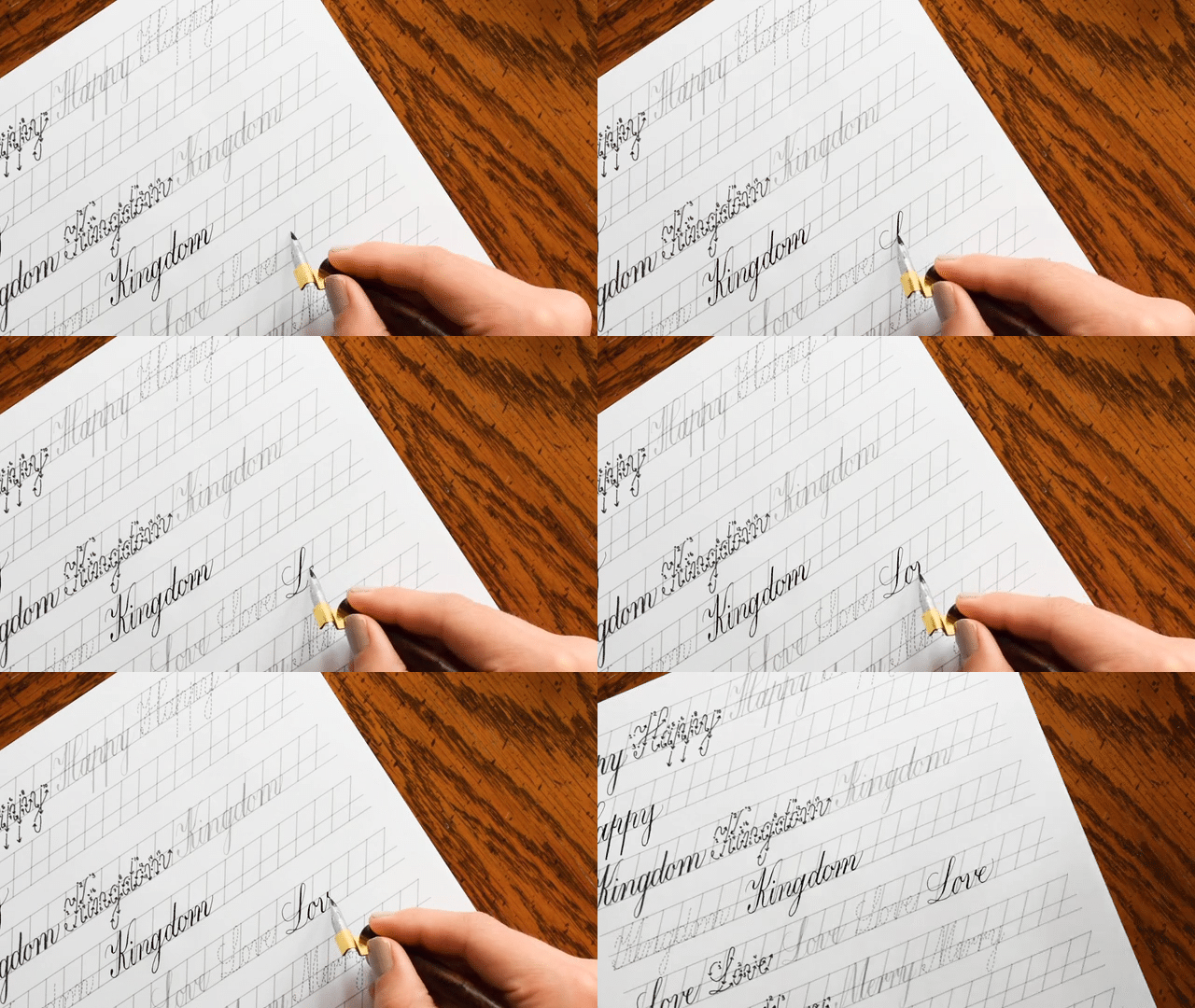
Knowledge of how to write in a bouncy, bohemian calligraphy style: I used Kaitlin Style calligraphy to address all of these envelopes. (Download a free exemplar here, get the full worksheet here, or learn it in the Beginner’s Modern Calligraphy Online Course.)
Ink with a thin viscosity, such as iron gall or walnut(affiliate link): Thin inks tend to flow easily and stay on your nib longer, which means less re-dipping and smoother writing. I used iron gall ink for all my envelopes.
Light-colored, high-quality envelopes: Thin inks don’t tend to be opaque enough to show up on dark-colored envelopes, so opt for something light-colored (the darkest I’d go is “Paper Bag” from Paper Source). A smooth texture is important, too! You can read about my favorite envelope sources here. Note: Avoid anything from Indian Cotton Paper Co. because the divots in that handmade paper, while gorgeous, will cost you extra time.
Pencil and eraser: While you won’t be drawing detailed guidelines, a few simple lines here and there can help.
Parallel glider: If you don’t have one of these, you can use a regular ruler, but the point of the parallel glider is to save you time!
Before I began my experiment, I came up with a (fake) address that was on the longer side:
I gave myself permission to make abbreviations (e.g. “Ln.” for “Lane”), and I encourage you to do the same! Also note that left justification will be your friend for all of these concepts. Centering calligraphy is a long, careful process. If you justify your words to the left, you’ll save a lot of time!
Quickest Envelope: Wavy Line
This envelope concept took me 4 minutes and 45 seconds to create (not including the time to choose and glue stamps). To make it, you’ll start by using your high-flex nib to draw a wavy line just below the horizontal center of the envelope.
It’s easiest to draw this line if you rotate the envelope so the short edges are at the top and bottom. (Basically, the opposite of how it’s shown here.)
Next, use all-lowercase calligraphy to write your recipient’s name hovering just above that wavy line. Take care to ensure that the calligraphy follows the line’s contours.
Finish up by drawing a pencil guideline that’s roughly parallel to the wavy guideline. Then, use casual all-uppercase sans serif lettering to write the address.
Wait for the ink to dry, then erase the pencil guideline. And voilà! A whimsical, unique envelope.
Another perk of using watery inks? They take much less time to dry than thicker inks like sumi or India.
Solid 5-Minute Envelope: Vertical Line
This envelope took me exactly five minutes to address, mostly because of the pencil guidelines that it requires. You’ll begin by using your pencil and your parallel glider to draw one vertical line in the center of the envelope (try to make it over 2″ [~5 cm]; but there’s no need for an exact measurement). Then, rotate the envelope to draw three or four horizontal guidelines that span roughly from the center of the envelope to the right side.
It’s perfectly fine to use a plain ruler for this step, but it will take longer.
Next, use your high-flex nib to write the recipient’s first and last name on the left in Kaitlin Style calligraphy. Try to vertically center the name in respect to the pencil guidelines on the right.
Then, switch to your medium-flex nib. Use it to write the recipient’s address in a sans serif all-uppercase style on the right.
Try to keep the space between the name and the vertical line the same as the space between the address and the vertical line. If horizontal spacing looks wonky, add a simple flourish.
Wait for your ink to dry, then erase the pencil guidelines to reveal an elegant, highly legible envelope.
Just Over Five Minute Envelope: All Calligraphy
If you want to write every part of your recipient’s address using calligraphy, this concept is a winner. While it took me the longest to write, it still only took 5 minutes and 30 seconds. To make it, use your pencil to draw four horizontal guidelines that are just under 1/2″ (~1.25 cm) apart.
Then, work at a 3/4″ (~2 cm) margin from the left to write each line of the address in Kaitlin Style calligraphy. I chose to use my high-flex nib for this; but the medium-flex nib will work, too, if you want a more delicate look.
As long as you maintain a right-leaning slant, you can use block lettering for abbreviations like “MT”.
Once the ink dries, erase your pencil guidelines, and enjoy your cleanly calligraphed envelope.
A Word on Postage
These envelope calligraphy concepts are all pretty simple, which means they need a little bit of help to shine. If you can, it’s a good idea to add vintage postage stamps to lend some visual interest and personality. Here’s what I recommend: buy contemporary stamps (“Forever” stamps, if you’re in the US). Then, separately, purchase a collection of vintage postage stamps in small denominations on eBay or a similar site.
Then, design a postage stamp collage. The contemporary stamp covers the cost of mailing, while the small denomination vintage stamps are purely decorative. If the concept of using multiple stamps or vintage stamps on an envelope is new to you, definitely read How to Use Vintage Stamps on Envelopes! In it, you’ll find tips for arranging postage stamps and specific places to find them.
If you’re sending a stack of holiday cards, you can always save the flourishing for another day. These ideas are meant to be efficient, but they don’t compromise on charm. Stick with one concept or try out all three to switch things up! It’s all about whatever gets your stack of cards out the door in a lovely, effective way.
To provide the best experiences, we use technologies like cookies to store and/or access device information. Consenting to these technologies will allow us to process data such as browsing behavior or unique IDs on this site. Not consenting or withdrawing consent, may adversely affect certain features and functions.
Functional
Always active
The technical storage or access is strictly necessary for the legitimate purpose of enabling the use of a specific service explicitly requested by the subscriber or user, or for the sole purpose of carrying out the transmission of a communication over an electronic communications network.
Preferences
The technical storage or access is necessary for the legitimate purpose of storing preferences that are not requested by the subscriber or user.
Statistics
The technical storage or access that is used exclusively for statistical purposes.The technical storage or access that is used exclusively for anonymous statistical purposes. Without a subpoena, voluntary compliance on the part of your Internet Service Provider, or additional records from a third party, information stored or retrieved for this purpose alone cannot usually be used to identify you.
Marketing
The technical storage or access is required to create user profiles to send advertising, or to track the user on a website or across several websites for similar marketing purposes.
Fuel your inspiration and creativity with TPK Premium Plus! Members enjoy three free worksheets or learning resources every month, unlimited video course access, member-exclusive tutorials, and a 10% discount on all Supplies Shop orders.
TPK’s innovative newsletters are an artistic treat. Join the 125K+ subscribers who have already discovered The Postman’s Knock, and receive 10% off your first Digital Catalog order.